Six weeks into a Mondly kick I didn't expect to stick, I got a push notification at 11:40pm reminding me I hadn't done my daily lesson, dismissed it without looking, and then lay there wondering why I felt guilty about an app. That's usually the sign I'm either about to fall off completely or actually going to stick with something for once.
I started keeping a running list of what everything actually costs after I re-subscribed to Babbel out of habit, forgot I had, and found four unused months sitting on a card statement I was supposed to be reconciling for a client invoice that same afternoon. Now I check this list before I renew anything, the same way I check an invoice line by line before I send it - which, given how I spend most Tuesdays, is often.
The phrase that actually landed for me, after months of getting it backwards, was the difference between siamo and stiamo (I still cannot type either one without pausing). It clicked - properly clicked - somewhere between ordering prosciutto at a deli counter and watching the guy behind it switch to English out of mercy before I'd finished my sentence. That's the kind of moment none of these apps can manufacture for you, no matter what the marketing copy says about "real-world conversations."
Pimsleur's narrator lives in my head rent-free at this point - that particular cadence before every repeat drill, the little pause that always makes me feel like I'm being tested. Duolingo's owl I muted the reminders on within the first month; I don't need the guilt trip on top of my own. And no app, in seven years of paying for a rotating cast of them, has made a grammar drill feel like anything other than eating my vegetables. Verb conjugation is eating my vegetables. I've made my peace with it.
Below is what I actually found this week when I went back through every subscription page myself - current prices and language counts, not the ones I half-remember from whenever I originally signed up. A few of the old numbers I'd been citing turned out to be wrong or just gone; I've noted where and why under the table.
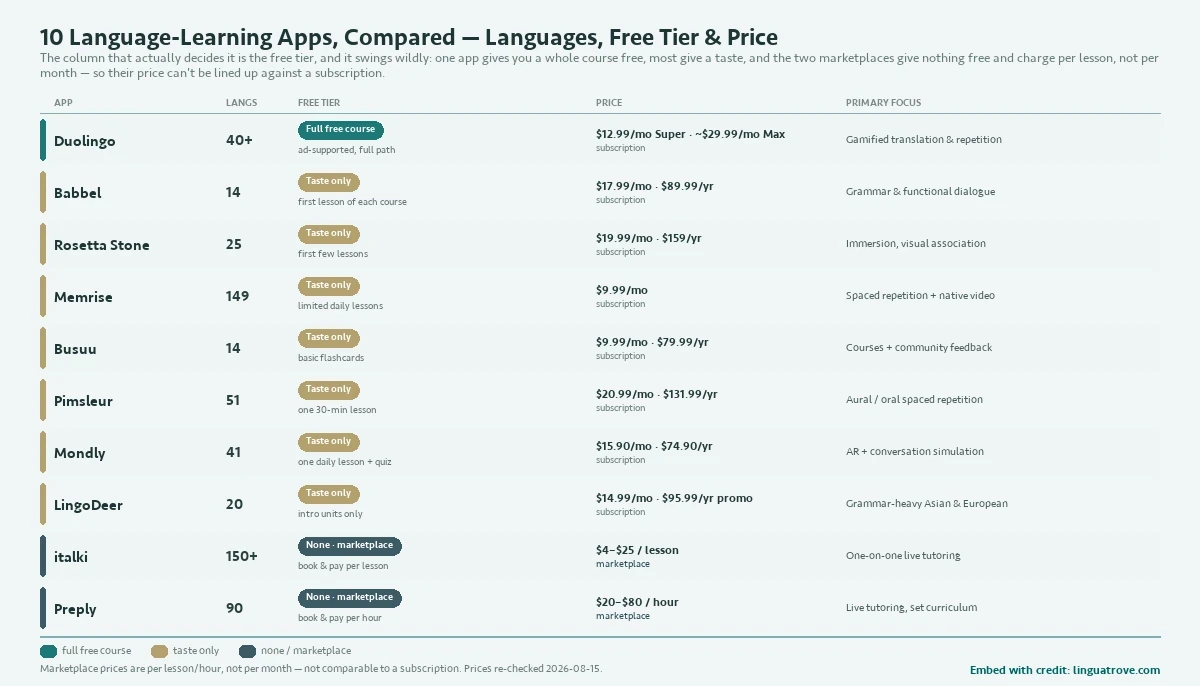
Comparison of Major Language Platforms
| Platform | Languages Offered | Free Tier Availability | Standard Monthly Price (USD) | Primary Learning Focus |
|---|---|---|---|---|
| Duolingo | 40+ [1] | Ad-supported, full course access | $12.99/mo (Super) [1] / ~$29.99/mo or $167.99/yr (Max) [2] | Gamified translation and repetition |
| Babbel | 14 [3] | First lesson of every course only | $17.99 (1 mo) / $89.99 (12 mo, single language) [3] | Grammar and functional conversation |
| Rosetta Stone | 25 [4] | Limited trial (first few lessons) | $19.99/mo or $159/yr (billed yearly) [4] | Immersion and visual association |
| Memrise | 149 [5] | Limited daily lessons and video clips | $9.99/mo [2] | Spaced repetition and native speaker video |
| Busuu | 14 [6] | Basic flashcards (limited) | $9.99/mo or $79.99/yr [7] | Structured courses with community feedback |
| Pimsleur | 51 [8] | One free 30-minute lesson | $20.99/mo (All Access) or $131.99/yr [8] | Aural/oral Spaced Repetition (SRS) |
| Mondly | 41 [9] | One daily lesson and weekly quiz | $15.90/mo or $74.90/yr [9] | Augmented Reality and conversation simulation |
| LingoDeer | 20 [10] | Introductory units only | $14.99/mo or $95.99/yr, 40% off promo (list $159.99/yr) [11] | Grammar-heavy Asian and European languages |
| italki | 150+ [12] | No (Marketplace model) | $4-$25 per lesson typically ($4-$20 Community Tutor / $10-$40 Professional Teacher) [13] | One-on-one live tutoring |
| Preply | 90 [14] | No (Marketplace model) | $20-$80/hour, per Preply's own pricing guide [15] | Live tutoring and curriculum-based learning |
Platform Methodologies and Features
- Duolingo
- Utilizes a gamified "tree" or "path" structure where users complete translation, listening, and speaking exercises. The Max tier, introduced in 2023, sits above Super Duolingo with two AI features built on OpenAI's GPT-4 - Video Call and Roleplay - available in 188 countries [16]. One feature that used to be Max-exclusive, Explain My Answer, went free for every Duolingo user on January 1, 2026 [17], which was a genuinely decent thing for them to do and also made me feel slightly better about never upgrading past Super.
- Babbel
- Focuses on dialogue-based exercises tied to real-life situations like travel or business, emphasizing grammar rules and sentence construction. Babbel's own materials point to research from Yale, CUNY, and Michigan State, and claim you'll be speaking within three weeks [18]. I won't vouch for three weeks specifically, but the dialogue format is the reason I can still order coffee in German without thinking about it.
- Rosetta Stone
- Employs the "Dynamic Immersion" method, which avoids translating into your native language entirely. Instead you get carefully sequenced images and native-speaker audio, building meaning through inductive reasoning rather than a dictionary lookup [19] - a lot of pointing at pictures of bread until it clicks.
- Pimsleur
- A primarily audio-based system centered on the "Pimsleur Method," which involves graduated interval recall (spaced repetition), the principle of anticipation, and core vocabulary focus [20]. This is the one where the narrator has more personality than some coworkers I've had.
- italki and Preply
- These platforms are marketplaces, not curricula - you book a tutor directly and pay per lesson on your own schedule, no app-designed path involved. italki draws a formal line between Professional Teachers, who bring formal qualifications and structured lesson plans, and Community Tutors, who are not formally trained teachers and mainly offer informal conversation practice at a lower price floor [13]. Preply works the same basic way, minus the two-tier labeling.
Last verified: 2026-07-17. A handful of the URLs I was citing before had quietly gone dead or stopped rendering anything a script (or a person clicking through) could actually read - Duolingo's and Memrise's own pricing pages are both client-rendered shells with nothing in the raw page, and Babbel's pricing page currently serves compressed data my tools can't unpack even though it loads fine in a browser. Where that happened, I swapped in whichever live, readable page actually said the thing I was citing it for, usually an official app store listing. I dropped the Rosetta Stone lifetime tier and the old Mondly and Memrise annual prices entirely rather than guess at numbers I couldn't confirm anywhere current.
Sources
- Duolingo: App Store Listing (Languages, In-App Pricing)
- Memrise Blog: MemBot vs Duolingo Max (Pricing Comparison)
- Babbel: App Store Listing (Languages, In-App Pricing)
- Rosetta Stone: Plans and Pricing
- Memrise: About Us (Language Count)
- Busuu: Premium Plans
- Busuu: App Store Listing (In-App Pricing)
- Pimsleur: App Store Listing (Languages, In-App Pricing)
- Mondly: App Store Listing (Languages, In-App Pricing)
- LingoDeer: Pricing
- LingoDeer: App Store Listing (Languages)
- italki: Homepage (Language Count, Teacher Count)
- italki Blog: How Much Does italki Cost? Complete Pricing Guide
- Preply: About Us (Languages, Tutors, Countries)
- Preply Blog: Make Sense of Private Tutoring Rates
- Duolingo Blog: Introducing Duolingo Max
- Duolingo Blog: Explain My Answer Is Now Free For All Learners
- Babbel: The Babbel Method Explained
- Rosetta Stone Support: Immersion-Based Learning Method
- Pimsleur: The Pimsleur Method